

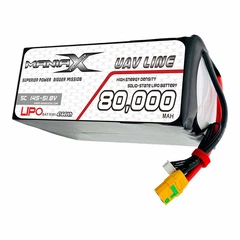


Instructions for use and safety instructions for Lithium-Polymer Batteries (Li-Po)
The warnings and instructions must be followed at all times.
Read before use!
General
- The cells must not be opened or damaged.
- The battery must not be curved or pushed.
- Damaged or bloated cells must not be used and must be disposed of properly. There is a risk of fire. It produces toxic gases and it can cause acid burns or poisoning.
- Li-Po batteries are sensitive to overcharging or undercharging.
- A deep discharge will destroy the battery. The voltage should be tested without load and at rest and should not be less than 3.75V per cell. The battery should NEVER be discharged below 3.2V per cell. It is recommended to leave a remaining capacity of 20% in the battery.
- Never short-circuit the battery! The discharge lines and the lines of the balance connector must never touch. A short circuit in the battery can cause an explosion and fire. It produces toxic gases and it can cause acid burns or poisoning.
- Always pay attention to the undamaged condition of the cables.
- DO NOT solder directly to the battery, never let the battery get hot.
- DO NOT store or transport in direct sunlight, hot car or similar storage locations.
- DO NOT put in rain or moisture.
Charging or discharging currents are generally indicated by C. Where 1C means the simple capacity. So if a battery has a discharge rate of 10C this means that the battery can be permanently emptied with a maximum of 10 x the capacity.
For example, a 2200mAh (2.2Ah) battery can permanently deliver 10 x 2.2A = 22A without being damaged.
It can take up to 5 cycles (charge and discharge) until the battery reaches its full capacity.
Charging the Li-Po battery
- The battery may only be charged with chargers suitable for lithium-polymer batteries with the appropriate charge program!
- It is essential to follow the instructions of your charger as well as the correct settings!
- Never overcharge the battery. The maximum charge and voltage must be followed.
- The final charge voltage is 4.2V per cell.
- The battery should only be charged outdoors or in fireproof containers.
- The battery should not be charged near or on flammable objects or surfaces.
- Do not charge the battery in rain or moisture.
- Always pay attention to the polarity!
- Only undamaged and cold batteries may be charged.
- Do not recharge the battery immediately after use, but allow it to cool down.
- Never exceed the maximum charging rate.
- The recommended charge rate is 1-3 C, and higher to 5C.
- We recommend always charging the battery with a charger with balance.
- If the battery is only charged via the discharge lines, sooner or later there will be a voltage difference between the individual cells of the pack (cell drift).
- A balance watches over the individual cells of the pack and equalizes the voltages and thus ensures a much longer life expectancy of the battery.
- After the charging process has finished, the battery must be disconnected from the charger.
Never leave the battery unattended while charging.
Discharging and use
- Before each use, check the battery is damaged or bloated. Damaged or bloated cells must not be used further and must be disposed of properly.
- The battery should not be operated in rain or moisture.
- Only cold batteries may be used.
- The maximum discharge rate must not be exceeded.
- Make sure that the maximum current to be supplied matches the requirements of your model.
- Secure the battery firmly and securely in your model.
- The battery should NEVER be discharged below 3.2V per cell. It is recommended to leave a remaining capacity of 20% in the battery. If the voltage falls below the voltage, the battery will be damaged and begin to decompose. The decomposition process continues and the battery bloats up and is unusable.
- In order to avoid a deep discharge, it is recommended to use a suitable system, e.g. about the telemetry, about informed of the condition of the battery.
- Always pay attention to the polarity!
- The battery must be disconnected after use and removed from the model.
- The battery must not exceed a temperature of 60° in use.
Storage and transport
- DO NOT store or transport in direct sunlight, hot car or similar storage locations.
- DO NOT put in rain or moisture.
- Always make sure that there is no short-circuit with the cables of the battery itself or with surrounding objects.
- Please note that also in some car rugs conductive fibers are processed!
- Do not store the battery near flammable objects.
- Store the battery in fireproof containers.
- Never store the battery completely discharged! For longer storage, the battery should be charged with 2/3 of its capacity.
Some chargers have separate charging programs for storage (Storage).
Environmental not
Battery law
According to the legal regulations batteries and rechargeable batteries (marked by the symbol of a crossed-out wheeled bin) must not be disposed of with household waste. If you are an end consumer, you are obliged to return waste batteries that contain harmful substances to us as a distributor or to collection points set up by public waste disposal authorities (eg: public collection points of cities and municipalities). As a result, you can return your old batteries and rechargeable batteries with sufficient franking to us.
For lithium-polymer batteries, the following points should be noted:
- Only put completely empty batteries into the disposal!
- The poles are to be secured against short circuit with an adhesive strip!
- Only place in a bubble wrap or original packaging in the disposal container!
Identification: