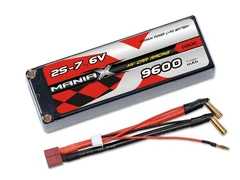
In FPV racing, the battery is not only stores energy but also dictates how your drone accelerates, corners, and sustains flight. A high-performance lithium polymer (LiPo) pack, tailored to your setup, can significantly improve throttle response and lap times. And below these key parameters and features will make you understand more clear.
Battery Chemistry – Why LiPo Dominates
Lithium polymer (LiPo) remains the gold standard for FPV racing due to its outstanding power-to-weight ratio, flat discharge curve and high discharge capabilities. These characteristics make LiPo the ideal choice for delivering explosive acceleration. While lithium-ion packs offer higher energy density, they typically cannot meet the extreme discharge demands of racing.
Voltage – The Core of Power
Motor speed is governed by the formula: RPM = KV × Voltage.
4S (14.8V nominal): Commonly used by beginners, it offers smoother power delivery, gentler throttle response, and easier handling while learning.
6S (22.2V nominal): The standard for competitive FPV racing, offering roughly 50% more power at the same current compared to 4S. This results in higher RPM, more thrust, improved efficiency, and reduced system stress. However, it requires compatible ESCs and motors to safely handle the higher voltage and power levels.
Discharge Rating (C-Rating) – Burst Power
The C-rating indicates how quickly a battery can release stored energy.
Formula: Max Continuous Current = Capacity (Ah) × C-Rating.
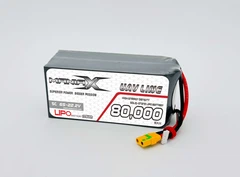
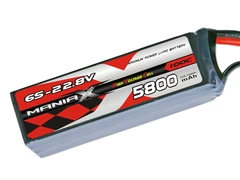
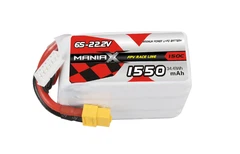
For example, a 1500mAh (1.5Ah) 100C pack can deliver up to 150A continuously. This is critical in maintaining voltage under full throttle, where huge current demands are made. Insufficient discharge capability leads to voltage sag, loss of power, and in worst cases, video feed brownouts or flight controller resets. ManiaX lipo battery packs can rate up to cont. 150C and provide consistent power with minimal sag, ensuring reliable performance during demanding maneuvers.
Capacity (mAh) – Balancing Flight Time and Weight
Capacity determines how long a pack can sustain high current draw, but comes with a trade-off in weight.
<1300mAh: Ultra-light, extremely agile, but flight times are limited to just over a minute, ideal for short technical tracks.
>1500mAh: Longer endurance but reduced agility due to added weight, impacting acceleration and cornering.
1300–1500mAh: The "sweet spot" for racing, offering 2–3 minutes of aggressive flying-perfect for most heats-while keeping weight manageable.
Weight – The Decisive Factor in Handling
Every gram matters. Lighter packs improve thrust-to-weight ratio and agility, particularly in tight corners. Between two batteries of the same specification, the lighter one typically uses higher-quality, lower-resistance cells-an advantage in racing scenarios.
Battery Care and Maintenance
Charging: Use a balance charger at 1C (e.g., 1.5A for a 1500mAh pack). Fast charging can shorten battery lifespan.
Storage: Keep packs at 3.80~3.90V per cell when not in use to prevent over-discharge or swelling.
Voltage Cutoff: Avoid discharging below 3.50V per cell to prevent damage.
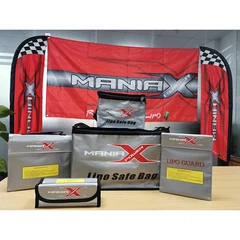
Safety Checks: Regularly inspect for swelling or physical damage. Dispose of compromised packs safely in a LiPo bag.