
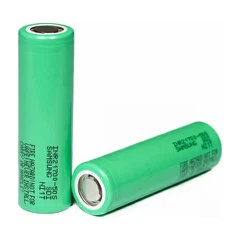

The structure of a cylindrical lithium-ion cell typically comprises four primary components-the cathode, anode, separator, and electrolyte-along with auxiliary components such as the casing, cap, gasket, and safety valve.
Assuming identical chemical systems and materials, cylindrical cells boast a more mature manufacturing process compared to prismatic and pouch cells, offering distinct advantages in terms of high product consistency, enhanced safety, and lower cost.
Currently, based on physical dimensions, commonly available cylindrical cells on the market can be broadly categorized into small-format and large-format types. Typical small-format cells include the 18650 and 21700 models; in their nomenclature, the first two digits denote the cell's diameter, while the subsequent two digits indicate its height. Large-format cylindrical cells are exemplified by the 46-series 4680 cell, and also encompass models such as the 34-series (34110, 34120) and the 40-series (40135).
The "full-tab" (or "tabless") design represents one of the core structural innovations found in large-format cylindrical batteries, such as the 4680 model. This design involves cutting the edges of the current collectors into a specific shape which, upon folding, forms a continuous conductive end face that is then directly welded to the current collector plate. Compared to traditional point-contact tabs, the full-tab design significantly expands the current conduction area and shortens the electron flow path, thereby substantially reducing the battery's internal resistance. For instance, the internal resistance of a 4680 battery utilizing the full-tab design can be reduced to below 15 mΩ. This design effectively enhances the battery's power output and fast-charging capabilities, while also boosting its energy density. Some large-format cylindrical batteries featuring the full-tab design support ultra-fast charging rates of up to 6C.
At the battery system integration level, Cell-to-Chassis (CTC) technology eliminates the need for traditional battery packs and modules by directly integrating cylindrical cells into the vehicle's chassis structure, thereby improving space utilization efficiency by 10% to 20%.