

Introduction
Medical drone delivery is rapidly becoming a critical piece of global healthcare infrastructure. From delivering life-saving blood and vaccines to remote rural communities to executing time-sensitive sample transfers within congested cities, drone logistics, including telemedicine and emergency response, are demonstrating immense commercial and social value. However, the full potential of these autonomous delivery systems is constrained by its most crucial component: the battery .
The Energy Trilemma of Medical Drones
Operators of medical transport drones face a core challenge that can be described as the "Energy Trilemma." This is the complex task of balancing three equally critical and often conflicting factors :
①Maximum Range: To serve remote populations and build a viable economic model, drones must fly as far as possible. This requires batteries with the highest possible energy density (Wh/kg). Every gram of battery weight directly reduces payload capacity and range.
②Absolute Reliability: When transporting life-saving supplies like blood or vaccines, or during emergency services, a power failure is unacceptable. The battery must provide 100% stable power under all conditions, including rapid takeoff, turbulent flight, and high payload weights.
③Exceptional Operational Efficiency: Drone transport is a business. To be cost-effective, operators need to maximize fleet uptime. This demands ultra-fast charging capabilities to minimize ground time, and long battery cycle life to reduce the cost of ownership.
Mission-Driven Solutions: A Tale of Two Battery Series
To solve this trilemma, ManiaX has developed a "mission-driven" battery architecture, recognizing that a one-size-fits-all solution cannot meet the diverse needs of medical logistics. The company has created two flagship product series tailored to different operational scenarios :
1. ManiaX Semi-Solid State Series: Built for "Breaking Boundaries" in Long-Haul Transport
This series is designed for missions that prioritize range above all else.
①Mission Profile: Connecting city hospitals with remote clinics (75-150 km range), often using VTOL drones to cross natural barriers. These drones transport high-value, temperature-sensitive payloads (1.5-5 kg).
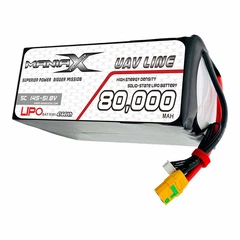
②Core Technology: The battery uses revolutionary semi-solid state chemistry to achieve an energy density of up to 400 Wh/kg. It utilizes high-nickel cathodes and silicon-carbon anodes in a lightweight structural design. This provides a 30-40% range increase and a 15-25% payload capacity boost compared to mainstream batteries.
The Bottom Line: Battery Technology is the Enabler
The success of medical drone delivery depends on choosing the right power solution for the specific mission. For inter-regional, long-range operations that expand access to rural healthcare, semi-solid state batteries are the key enabler. For high-frequency, high-efficiency, short-haul delivery systems that are critical for time-sensitive logistics, ultra-fast charging smart batteries are the clear choice. By understanding and applying these mission-driven power solutions, the medical drone industry can save more lives and build more resilient healthcare systems.


