

Detailed Analysis of Constraints
1. Voltage (V) and Motor KV Rating
This represents the most direct and critical constraint.
Motor KV Rating: Denotes the increase in no-load speed per 1V increase in voltage. For example, a 1000KV motor operating at 12V will achieve an idle speed of approximately 1000 × 12 = 12000 RPM.
Battery Voltage: Typically denoted by 'S' values (1S = 3.7V, 2S = 7.4V, and so forth)
Relationship:
Actual motor speed ≈ Battery voltage × Motor KV value
High KV motor + High voltage battery: This combination results in extremely high motor speeds and substantial current demands, easily exceeding the discharge limits of both the battery and ESC, leading to burn out.
Low KV motor + Low voltage battery: This combination yields insufficient motor speed, failing to generate adequate thrust. The drone may be unable to take off or exhibit poor maneuverability
.
Matching Guidelines:
Motor manufacturers typically specify a recommended voltage range. For instance, a motor marked 'Suitable for 4-6S' should be paired with batteries ranging from 4S (14.8V) to 6S (22.2V). For equivalent power requirements, a high-voltage, low-KV combination generally operates more efficiently than a low-voltage, high-KV setup, as it draws lower currents, reducing wiring losses and heat generation.

2. Battery Discharge Capacity (C-Rating) VS. System Current Demand
This concerns the trade-off between a power-train's 'burst capability' and operational safety.
System Maximum Current: The peak current drawn by a single motor/propeller combination at full throttle. Total current = Single motor current × Number of motors.
Maximum continuous discharge current = Battery capacity (Ah) × Discharge rate (C). For example, a 5000mAh (5Ah) 30C battery has a maximum continuous discharge current of 5 × 30 = 150A.
Constraint:
Battery maximum discharge current ≥ Total maximum current of all motors
If battery C-rating is insufficient: When the drone requires high thrust (e.g., rapid ascent, high-speed flight), the battery cannot supply sufficient current, causing its output voltage to plummet sharply (known as 'voltage drop'). This results in:
Insufficient power, leading to degraded flight performance.
Flight controller reboot or loss of control, potentially causing a crash.
Battery swelling, damage, or even fire due to excessive discharge.
Excessively high C-rate batteries: Whilst offering greater safety margins, they typically entail heavier weight and higher cost. A balance must be struck between these factors.
3. Battery Capacity/Weight VS Flight Duration/Efficiency
This represents the perpetual trade-off concerning endurance.
Energy Density: Greater battery capacity stores more energy, theoretically extending flight duration.
Weight trade-off: Higher-capacity batteries are invariably heavier.
Constraint relationship:
Flight time ∝ Battery capacity / (Total system power + Power increase due to additional weight)
This exemplifies diminishing returns:
You install a battery with 50% greater capacity.
This battery is also 50% heavier.
To compensate for this extra weight, the motor must consume more power to maintain flight.
Ultimately, the increase in flight time falls far short of 50%, and may even decrease due to excessive battery weight.
Therefore, when selecting battery capacity, one must consider its weight impact on the aircraft's thrust-to-weight ratio and motor efficiency. The optimal solution lies in finding the best balance between energy density and weight.
4. Efficiency Platform
Motor efficiency varies across different rotational speeds and loads. It possesses a 'maximum efficiency range'.
Battery function: To supply an appropriate voltage enabling the motor to operate precisely within its peak efficiency range during common throttle applications (e.g., hovering, cruising).
Constraints: Inappropriate battery voltage selection may cause motors to operate at low efficiency during hovering, converting substantial electrical energy into heat rather than thrust, thereby drastically reducing flight duration.
II. Practical Trade-off Examples
FPV Racing Drones:
Objective: Ultimate thrust-to-weight ratio and maneuverability.
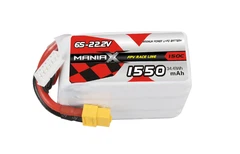
Selection: Typically employs high-KV motors (e.g., 2000KV+) paired with high-C, medium-capacity (e.g., 1300-1800mAh) 4S or 6S batteries. Sacrifices endurance for explosive power.
Aerial Photography Drones:
Objective: Extended endurance and flight stability.
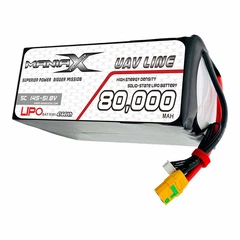
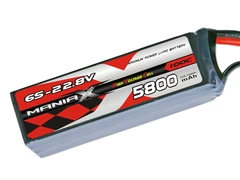
Choice: Typically employs low-KV motors (e.g., several hundred KV) paired with high-voltage (6S), high-capacity (e.g., 5000mAh+) batteries featuring high energy density. This high-voltage, low-current approach enhances overall efficiency, thereby prolonging flight duration.
Lightweight/Entry-Level Drones:
Objective: Cost control and simplified operation.
Selection: Employ low-voltage (2S-3S) batteries paired with corresponding medium-to-high KV motors. The system's power and current demands are relatively low, placing fewer stringent requirements on the battery and ESC.
The interdependent relationship between drone batteries and motors fundamentally constitutes a collaborative design challenge between the energy system and the propulsion system.


